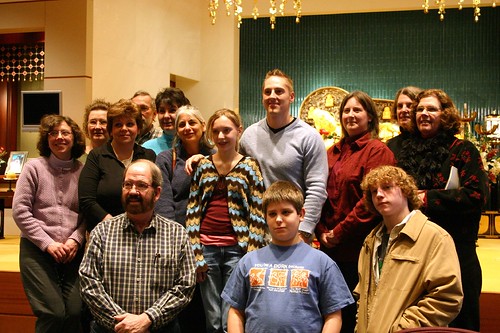
St. Nicholas with the Holy Innocents contingent at
the Shinnyo-en Buddhist Temple, 3 February 2007
Join us this Sunday as we begin our new music program.
Be with us this Sunday as we welcome our new music director, Mary Fletcher Gomez. During my time at St. Nicholas – and my shorter time at Holy Innocents — we have been blessed with some wonderful musicians. Mary continues that tradition and comes particularly to help us build an enduring, music program with a large and vibrant choir. One part of this will be the addition of our new organ, which we will arrive no later than Palm Sunday and will allow us to do both traditional and new music. So if you’ve been
thinking about joining the choir, now is a great time. And if you are already a part of the choir, Mary reminds choir members – and any who would like to join the choir – that the first rehearsal will be on February 11 at 8:15 a.m. sharp. During the week, rehearsals will be on Wednesday nights at 7 p.m., beginning on the 14th, with a time adjustment during the season of Lent.
Structure, structure, structure.
-
I confess that I’ve always been much better with spirit than structure, which is why I am so grateful to all of those now stepping forward to help us put structures in place to assist our new congregation – and its growth. Over the next few weeks you will be asked to help in several areas.
Greeting people as they arrive, assisting newcomers, and making sure the collection is done efficiently. Barbara will be the key contact on this.
-
“Yummy Hour” hosts. It is important that after each liturgy there be ample refreshments for folks. Hosts would be responsible for buying or making goodies and also for making the coffee and bringing other drinks. See Karen, who will coordinate this.
-
Cleaning crew. Many of us feel we can use our resources more effectively if we clean the church ourselves rather than paying for outside cleaning services. To make this work, we need volunteers. Manny is coordinating this.
-
Helping lead the liturgy, especially by reading or leading the intercessions. One of the things Manny, Paul, and Steve heard over and over at Catholic Theological Union was that liturgy is the work of the people. To make this a reality we need YOU to volunteer to help. Paul is organizing our sign up list, with help from Mary Anne and Pat.
Adult Education.
Now that we’ve concluded our three-week series on growing the church, we are beginning to put some new things in place. One of these is a two-group approach. The former St. Nicholas has had an adult ed group, convened by Steve Grunewald, Val’s husband, that has looked at a variety of issues relating to contemporary issues and faith. That group will continue, and they will pick up their ongoing discussion of world religions. New members are most welcome. Because Steve is Jewish, this group also has an interfaith
dimension. This week will continue the Buddhism discussion.
A second group, to be led by me and various others, will offer a mix of things. For the next two Sundays, they will give us a chance to do a bit of Bible study, as we look at the readings for the following Sunday. This is a great way to enrich our appreciation and understanding of the scriptures when we hear them proclaimed in church. Beginning on the first Sunday of Lent, Ethan Jewett will offer a three-week session on reading the Bible, followed by a three-week session on lectio divina, an ancient spiritual
practice based on individual engagement with both Scripture and silence. Then we will take a break for Palm Sunday, Easter Sunday, and our annual meeting, before picking up on April 23 with a series on “Getting to Know Our Episcopal Church.” This will offer newcomers an intro to the Church and to Anglicanism generally and will run through April and a bit beyond.
Bring food every Sunday.
We are going to highlight this offering on Sunday by having the children – and others, if they need help – bring all of the food brought that day to the altar. Let’s make sure there is lots and lots each Sunday. There will be if we each simply remember to bring one or two non-perishable items each Sunday. Place it on or beneath the table just inside the worship space so it can be part of the offertory.
One liturgy at 10 on February 18.
That day, in place of a Shrove Tuesday observance, we will gather for a single liturgy followed by a potluck. More details on food in next week’s email newsletter. Next year, when we hope to have our building addition – including kitchen – completed, we’ll have quite a Shrove Tuesday celebration. This year, given the myriad challenges of combining the congregations and getting things to go smoothly, we thought everyone would appreciate a more leisurely time to eat and converse and continue to get to know one
another.
Lent’s a comin’
Hard to believe, but Lent is just around the corner. We’ll mark the beginning of the season on Ash Wednesday, February 21 with a liturgy at 7 p.m.
Be on time.
Because our Sunday schedule is so tight – with worship at 9 and 11, and our education hour sandwiched in between at 10, it helps if all can be a few minutes early. Ready or not, we are going to try to start everything on time. Thanks.
Be a friend.
Make yourself a name tag each Sunday. It will help us get to know one another faster, and it’s a great way to make guests feel welcome.
One bread, one body.
We’ve been through a lot in this first month of our life together. I am so grateful to all who have pitched in – and a little guilty. Yes, it’s time for an early Lenten confession. I have felt absolutely swamped this past month. Some of it is the coming together of our two congregations. But also, I have been hard at work on my thesis for the Jung Institute, and that has consumed every extra moment I can find.
I confess this because I’d really like to be giving my extra moments to the church right now, but I’ve decided in the long run it will be better for me – and for us as a congregation – if I can finish this program and graduate in June. The good news is that writing the thesis and then defending it in a June exam are the last remaining pieces for me in analytic training.
The bad news is that I’ve got to complete it by April 1 – no foolin! – in order to graduate in June. I am pretty sure I can do it; I’ve completed about 30 of the necessary 80-100 pages written, and they are probably the hardest 30. Anyway, if I seem extra ditzy, or my follow through isn’t what it normally would be, that’s probably why. It is also the reason I am preaching only once a month January to March.
The best news is that I am writing on the archetype of the Good Shepherd and am very excited by what I am doing. I intend over the coming years to go more deeply into the Good Shepherd and ultimately rework the thesis for publication. I also look forward to sharing some of this material with you in a Fall workshop – and more than likely, you’ll be hearing a lot about the Good Shepherd in my homilies for years!
My most surprising finding so far has been that the representations of the Good Shepherd – the favorite image of Christ among the early Christian artists – are surprisingly sensual and arguably homoerotic. Maybe Dan Brown (The DaVinci Code) was right – or part right. Seriously, it is interesting that when we begin to delve deeply into early Christianity, the material is much more complex and much more interesting than we ever imagined or were told.
In any event, the Good Shepherd image disappeared from Christian art in the fifth century, and was replaced by a stylized lamb of the Apocalypse. And Christianity has seemed more comfortable with power than the body ever since.
— Steve