Christmas Eve 2010 – 430pm and 9pm

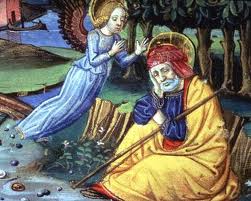
Angel and Joseph

An angel of the Lord appeared to him

in a dream and said,

“Joseph, son of David,

do not be afraid to take Mary as your wife,

for the child conceived in her

is from the Holy Spirit.

She will bear a son,

and you are to name him Jesus,

for he will save his people from their sins.”

— from the Gospel of Matthew

Holiday schedule

As is our custom, we will worship at 4:30 and 9 p.m. on Christmas Eve.

The 4:30 p.m. “Family Mass” will have a new wrinkle this year, as it will open with an abbreviated Lessons and Carols. Please bring poinsettias or flowers if you wish to put around the altar or the Lady Shrine.

The 9 p.m. “Candlelight Mass” will also open with Lessons and Carols, as it has for the past two years. Please bring poinsettias or flowers if you wish to put around the altar or the Lady Shrine.

Our schedule during the remainder of the Christmas season is:

  • Saturday, December 25 — no liturgy (please join us on Sunday)
  • Sunday, December 26 — worship at 10 a.m.
  • Saturday, January 1 — no liturgy (please join us on Sunday)
  • Sunday, January 2 — worship at 10 a.m.

Colin Slee, Bishop of Southwark: a true son of St Nicholas

Today at St Nick’s we celebrated the Feast of Saint Nicholas (it’s actually tomorrow, so it was “transferred” to Sunday).

Father Steve’s homily was a fun series of stories, each with its own slightly wacky hat. Before the service, we were all asked to leave our shoes out for St Nicholas in the gathering space (adults and children both). After the service, there was CANDY in your blogger’s snow boots, thoughtfully packed in an odor-proof plastic bag. Thank you, St. Nicholas!

We have St. Nicholas to thank for the life of a great Anglican who passed away recently, The Very Revd Colin Slee, Dean of Southwark in London. Following are some excerpts from the funeral sermon, preached by Jeffrey John, Dean of St Albans. For many reasons, Dean Jeffrey was exactly the right person to remember the Very Revd Colin Slee.

One of the last things Colin said before he died was, ‘I am surprisingly un-scared’. It could have been the motto of his whole life. Colin was always surprisingly un-scared. Unlike the rest of us, he never did let fear or self-consciousness or embarrassment to stop him reaching out to the most unlikely and needy people, or doing and saying what he thought was right and true. All the frightened, careful people said Colin was risky, indiscreet, unreliable – ‘the most dangerous man in the Church of England’ said one, to Colin’s deep delight. But he was not dangerous or indiscreet or unreliable – certainly not in anything that mattered. He was just surprisingly un-scared.

If you ask why he was so un-scared, I think the answer is as straightforward as he was. He really did believe. He really trusted in a good and loving God as Jesus came to make Him known to us; and that confidence set him free to be the astonishingly life-giving, brave, generous and joyous person that he was.

That faith never wavered, not even in the few weeks between the diagnosis and his death. A fortnight ago Colin asked me to say something at a service he had been due to preach at in St Albans. He said this:

‘People have been shocked by the suddenness and seriousness of my illness, and some have asked ‘Why you?’ Well, why not me? We believe in a God who creates a world with freedom for life, and freedom means the potential for going wrong. Cancer is life gone wrong. But if God didn’t let go and let go wrong, He would be less than the God of the Gospel’.

Other people had said to him ‘It’s not fair: you’ve led a good life’. Colin replied, ‘How do you know? And anyway, whatever goodness I have is God’s gift. We rely on mercy, not fairness’.

Dean Colin took good care of the people of Southwark Cathedral and indeed wherever he had served, and his death is a great loss to many. As it happens your blogger, unaware that the bishop was dying, tried to visit Southwark Cathedral on a recent trip to London, having heard that it was one of the most welcoming and dynamic communities in London. A baccalaureate service was about to begin, and although it was open to visitors, it wasn’t the best time to be wandering around looking at monuments. The cathedral itself is not large and is undergoing a major renovation in the “front,” where it snubs up against a railway bridge. But there’s a modern annexe that adds welcoming space and a cafe on one side, and a tiny garden with a wandering walkway on the other. It offers hospitality to the stranger in the best way; with benches, a quiet place to regain one’s composure away from the noise and confusion that is modern London, and even picnic tables for office workers from the surrounding area. It appears that Dean Colin was a friend to students as well, and he might have thought it appropriate for the students to get on with their professional lives after completing their academic ones, as he lay completing his own life surrounded by family and friends and getting ready to begin his life in glory.

There are many funny stories about Dean Colin, including the one about the time he gleefully jumped up and down in full canonicals to demonstrate the dangerous “wobble” in the Milennium Bridge, just as Queen Elizabeth was standing by to cut the ribbon; he was on hand to bless it. She opened it, he blessed it, and a few days later it was closed for urgent repairs.

As it happens, your blogger actually witnessed the arrival of the Archbishop of Canterbury at Dean Colin’s Thameside home for what must have been a pastoral care visit. The residence, known as the Provost’s Lodging, is two doors down from the Shakespeare’s Globe theatre; the house has a cheerful yellow door and the front windows have a view of the “wrong Cathedral,” St Paul’s, on the north side of the river. There was no pomp, no circumstance; it was the visit of a friend to a man whose valiant fight for life was nearly done.

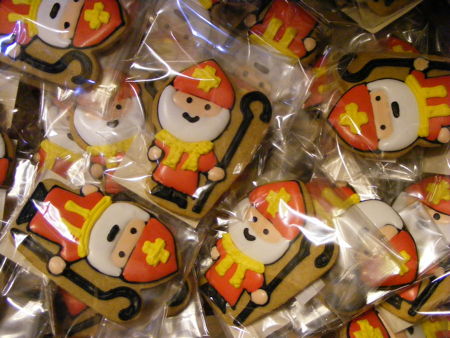
After the funeral service for Dean Colin, St Nicholas biscuits were given to those in attendance:

Don’t be surprised if when you leave this service a biscuit is pressed into your hand in the shape of Santa Claus. Something I only learned about Colin this week is that his patron saint was Nicholas, because the name Colin is apparently a diminutive of Nicholas in Scots Gaelic. Nicholas does seem terribly appropriate. A big man with a big heart who laughs a lot; a man who loves God and people, especially children; a generous man who gives away all he’s got; a man who goes out to the poor and outcast and defends the weak against the strong. It was also Nicholas – let us remember – who at the Council of Nicea is said to have punched Arius the heretic on the nose because he was misrepresenting Jesus and failing to show the full extent of God’s love in the Incarnation. As patron saints go, that was, it seems to me, a remarkable fit.

A true son of Nicholas, like one of the sons described in Father Steve’s light-hearted sermon this morning, has left us; it is up to us to live up to his example and stand up for all people, shelter all people, and welcome all people:

Someone said about Colin, ‘He was such a big man. We felt we could shelter behind him and he would stand up for us and protect us’. That is true, but it should also make us ashamed. Why was it so often left to him and him alone to stick his head above the parapet? Why did he have to pay the price of telling the truths that every single one of us here knows?

Colin chose the Emmaus Road Gospel for his requiem because he wanted us to understand that the risen Christ still walks with us even if we can’t see him. And in this breaking of the bread Christ can still open our eyes, to see that all those who have died in him are present with us too. As the Bishop says in the Preface, ‘we join with angels and archangels, with Colin and with all your faithful people’. In the Communion of Christ’s Body, death doesn’t divide us. And as we pray for Colin, I don’t doubt he is praying for us – that we’ll have the same confidence in God’s goodness that he had, and go out from here to be more big-hearted and more truthful and un-scared ourselves.

Lord Jesus, open our eyes in the breaking of the Bread.

Amen.

And amen.

Thank you, good Saint Nicholas, for sending your spiritual son Colin to the people who needed him, and thank you for welcoming him into your warm embrace.

The family suggests donations to the sister diocese of Southwark, Masvingo in Zimbabwe.
What Time Is…?? How Churches Can Use Service Times To Better Serve All

Typically, St Nicholas has quite a late Christmas Eve service, but has added in recent years an earlier service for families and others who prefer to be out and about during daylight hours. With Christmas Eve on a normal weekday, many can’t get the time off for an earlier hour.

What to do? Watch this space for announcements of Christmas Eve services, but here are some suggestions for offering services that are really intriguing from a scheduling point of view.

Christmas is an opportunity for churches to seize upon the folk lore, myths and glitter of the season to do some effective evangelism. Special holiday services that offer a wide variety of worship styles and music will attract people who would ordinarily ignore your church, if they are effectively publicized.

Here is a list of suggestions on what your church can do.

Offer a variety of services and music. Advent and Christmas lessons and carols, plays, musicals and concerts that include both popular and traditional music are all ways to reach people who do not regularly attend church. This Christmas Eve at my parish, we plan to offer a 4:00 pm Christmas Pageant and Communion Service, a 7:00 pm Christmas Jazz Mass and an 11:00 pm Solemn Choral Eucharist. Your Christmas Eve worship may be different. The important thing is to know the people you want to reach and then develop the worship services that will build bridges between their world and yours.

Limit your services to an hour. People today have short attention spans, thanks to television and computers. Long, wordy services are tedious; your worship needs to flow and move quickly. In divinity school, I was taught the value of an “economy of words”– succinct language that avoids unnecessary verbiage. The Prayers of the People, for example, should be concise and to the point. Resist the temptation to pray for every conceivable need in the world and instead focus on four or five key petitions. Similarly, choose Eucharistic Prayer 2 in the BAS or some other that is not overly long. The rule for Christmas Eve worship: Keep it short, keep it simple, and make the main point the only point of the service.

Think outside the box in scheduling services. Increasingly, churches are holding Christmas Eve services at 2:00 or 3:00 in the afternoon to accommodate older people who do not want to drive in the evening. Afternoon worship also meets the needs of families and singles who will be away on Christmas Eve and unable to attend worship. In my former parish, our 2:00 pm Christmas Eve Eucharist had close to 300 in attendance. Another parish had over 200 at its 3:00 pm service. An early afternoon service is a nice complement to a 5:00 pm Family Service and the late night Christmas Choral Eucharist. Incidentally, attendance continues to decline at late night services. Churches would be wiser to put their resources into offering a high quality 7:00 or 8:00 pm service. If a late night service is still preferred, hold it no later than 10:00 pm.

Market your services aggressively. Place the times and description of your services on the parish web site. Know the people you want to reach and then target those people in your advertising. If your budget allows, advertise on the radio or cable TV. Colorful banners and visible signs hung from the church or on the grounds also help to get out the word. Don’t let your holiday services be the best kept secret in town!

Fully print out the worship service in the bulletin. If you don’t have overhead screens, you need to print out the entire service. Yes, it takes a lot of work and may cost some money, but this is the one time of year you want to spend lavishly on producing an attractive, user-friendly worship bulletin. One of the most frustrating things for non-Anglicans attending our worship is to constantly flip pages in the Book of Alternative Services. Let’s face it: the BAS is not user-friendly. However, if ever there was a time for churches to have user-friendly worship it is during the holidays. Computer technology makes printing the entire service feasible for even a small church.

Be warm and welcoming to visitors. Greeters and ushers should smile, put visitors at ease and communicate the message: “We are glad you are here!” The worship bulletin should reinforce that message. On the front cover of every worship bulletin in my parish are these words: “Whoever you are and wherever you are on your journey of faith, you are welcome. Our one message is that God’s unconditional love is extended to you right now through Jesus Christ. Here in this church God says, ‘I will bless you. You belong. This is my family, and you have a place in it.”

Be sensitive to the non-baptized. There is nothing worse than attending a Eucharist and being told you cannot receive communion. Especially if you are a non-baptized seeker, the prohibition on receiving the sacramental elements may be profoundly hurtful. This is a sensitive issue theologically, and the church is still finding its way on the issue. As a pastoral matter, it is best not to use any exclusionary language in the worship bulletin and allow participants to make their own judgments about whether or not to receive communion. In my parish, we print these words in the bulletin: “All who seek God are welcome to the Lord’s Table to receive the Bread and Wine of Christ’s Body and Blood. Even if you do not seek God, you are still welcome because God seeks you. Come and hold in your hand and taste on your lips the love which we cannot comprehend.”

Never talk about money at a holiday service. There is a time to speak about the financial needs of the parish. Christmas is not that time. Too many non-churchgoers think of the church as only interested in their money. To address that concern, I recommend that in the worship bulletin you include this announcement: “If you are a visitor, please do not feel obligated to participate in the offering. We ask only that you fill out the Visitor’s Card located in the pew back and place it in the offering plate.”

Consider offering open baptism. Studies indicate that people are most open to a significant change in their lives during the holiday season from December through January. Take advantage of that by holding a special baptism service on the Sunday before or after Christmas, advertising in the community and encouraging people to come and be baptized or to have their children baptized. Don’t worry about teaching them all the details of the Christian faith–baptize them first, catechize them afterwards.

The sermon needs to be joyful, positive–and brief. Unless the parish is blessed with an exceptionally gifted preacher, no sermon should be more than 12 minutes–and 10 is preferable. Christmas is not the time to give a theological exposition of the Incarnation. It is a time to share the good news of God’s love for every human being, to assure people of their precious worth as children of God, to speak of God among us even in the tough times of our existence, and to declare that at the heart of the universe is not a black hole but the light and life of Eternal Love.

Via Anglican Journal: Guest opinion: What can your church do to evangelize this Christmas? and also via The Lead: Seize The Day! Christmast That Is